Table of Contents
- Introduction
- The Evolving Landscape of AI in Healthcare Marketing in 2026
- Core AI Technologies Reshaping Healthcare Marketing
- AI-Powered SEO and Generative Engine Optimization
- Chatbots, Voice Search, and Telehealth Marketing
- Human-in-the-Loop vs Human-on-the-Loop: Strategic Choice
- Competitor Landscape and Strategic Positioning
- Real-World AI Marketing Case Study
- Risks, Limitations, and Ethical Considerations
- Future Implications: 2026–2035
- Key Takeaways
- Conclusion
- FAQs
AI in Healthcare Marketing (2026 Guide)
Introduction
In 2026, patients no longer browse websites — they query AI systems. Google AI Overviews now appear in 51–89% of health-related searches, cutting traditional click-through rates by up to 61% for many queries. Google’s December 2025 core update further intensified scrutiny on YMYL content, rewarding sites with verifiable expertise while penalizing those lacking clear authorship or structured data.
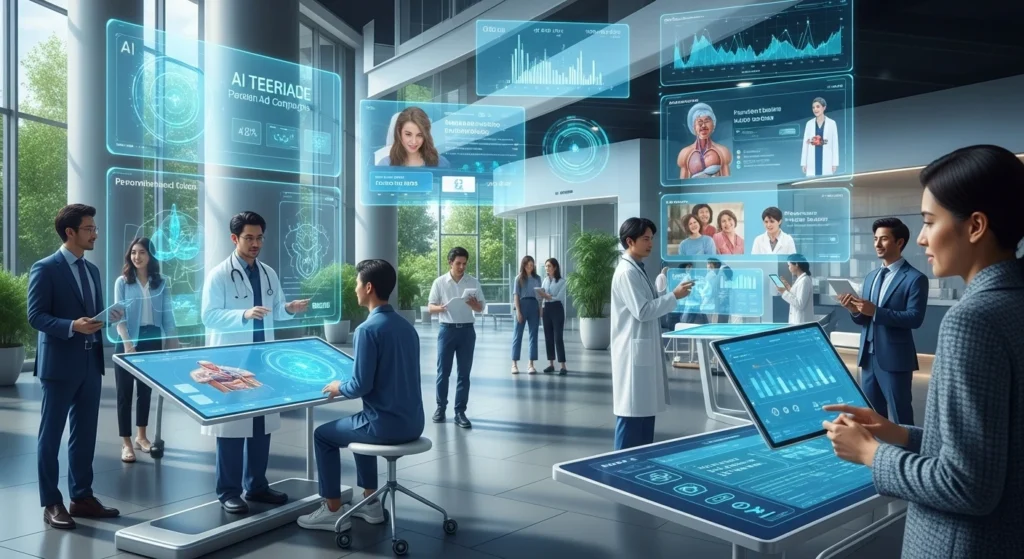
AI in healthcare marketing has evolved from an experimental tool into a core strategic layer. For clinics, hospitals, and telehealth providers, AI now powers everything from real-time patient engagement to predictive SEO and voice-optimized content. Practices that integrate AI responsibly gain measurable advantages in patient acquisition, while those relying on outdated tactics lose visibility.
This 2026 guide delivers an evidence-based framework for medical professionals and marketing leaders. It draws on the latest algorithm shifts, AI adoption data, and real-world outcomes from credentialed practices across the USA, UK, Canada, and Middle East. The focus remains practical: how to deploy AI while preserving clinical accuracy, regulatory compliance, and patient trust.
The Evolving Landscape of AI in Healthcare Marketing in 2026
Google’s December 2025 core update and the rapid expansion of AI Overviews have created a bifurcated search ecosystem. Informational health queries increasingly resolve via generative summaries, while local and transactional searches (“dentist near me,” “telehealth appointment”) still favor map packs and traditional results.
AI adoption in healthcare marketing has accelerated sharply. According to 2025–2026 industry analyses, 66% of physicians now use health AI tools (up 78% from 2023), and AI-powered marketing solutions are helping clinics recover visibility lost to AI Overviews. Tools for Generative Engine Optimization (GEO), HIPAA-compliant chatbots, and voice search are no longer optional — they are essential for maintaining organic reach, especially when combined with local SEO for doctors and Google Maps SEO for doctors.
Core AI Technologies Reshaping Healthcare Marketing
Key technologies include:
- Generative AI for content and SEO — Tools that structure content for citation in AI Overviews.
- Conversational AI (chatbots) — HIPAA-compliant systems handling appointment booking, triage, and FAQs.
- Voice search optimization — Natural-language processing tailored to spoken queries.
- Predictive analytics — Forecasting patient intent and optimizing campaigns in real time.
These systems enable autonomous decision-making in routine tasks while requiring human oversight for clinical and ethical integrity. AI also supercharges local SEO strategy for clinics by automating citation building, review responses, and map-pack signals.
AI-Powered SEO and Generative Engine Optimization
Traditional SEO has shifted toward GEO — optimizing for AI-generated answers rather than blue-link clicks. Clinics must now create structured, quotable content with clear schema, question-based headings, and verifiable sources.
Comparison: Traditional SEO vs. AI-Powered Healthcare Marketing (2026)
| Aspect | Traditional SEO (Pre-2025) | AI-Powered Marketing (2026) |
|---|---|---|
| Primary Goal | Blue-link rankings | Citation in AI Overviews + conversions |
| Content Focus | Keyword density | Structured, authoritative, patient-intent |
| Measurement | Traffic volume | Visibility in generative results + bookings |
| Human Role | Full manual control | Human-in-the-loop validation |
According to Ahrefs 2025–2026 reports, healthcare queries show the highest AI Overview trigger rates, making GEO essential for sustained visibility. This is especially powerful when paired with healthcare SEO and dermatology SEO strategies.
Chatbots, Voice Search, and Telehealth Marketing
Chatbots and voice assistants now handle initial patient interactions 24/7. HIPAA-compliant AI chatbots improve conversion by answering queries instantly and routing complex cases to staff. Voice search optimization — using conversational phrasing and FAQ schema — is critical as smart speakers and mobile voice queries grow.
Telehealth SEO benefits directly from AI: optimized landing pages with schema for virtual visits, combined with chatbots for seamless booking, reduce drop-off rates and improve patient experience. AI also enhances local SEO for doctors and Google Maps SEO for doctors by predicting local intent and automating GBP posts.
Human-in-the-Loop vs Human-on-the-Loop: Strategic Choice
The debate is settled in regulated healthcare environments: human-in-the-loop (HITL) remains the standard. AI generates drafts, suggestions, or initial responses; licensed professionals review and approve outputs for accuracy and compliance. Human-on-the-loop (HOTL) — where AI operates autonomously with occasional monitoring — is suitable only for non-clinical tasks like basic scheduling.
Most successful implementations in 2025–2026 favor HITL for content creation, chatbot responses, and SEO recommendations. This approach maintains E-E-A-T signals while scaling operations safely. For deeper analysis on integrating AI with local SEO strategy for clinics, see our dedicated resources.
Competitor Landscape and Strategic Positioning
Tier 1 Direct Competitors (healthcare-specialized): Intrepy Healthcare Marketing, Cardinal Digital Marketing, Stethon Digital Marketing, Thrive Internet Marketing Agency, WebFX, and Real Chemistry lead through deep niche expertise and AI-integrated case studies.
Tier 2 High-Authority Agencies: Ignite Visibility, SmartSites, Searchbloom, Intero Digital, and Coalition Technologies.
Tier 3 Local/Growth Players: Funnel Boost Media, Scorpion, First Page Sage, and PatientGain excel in local AI-optimized patient acquisition.
Leaders share high-quality backlinks from authority domains such as Mayo Clinic, Cleveland Clinic, WebMD, and Healthgrades, along with demonstrated E-E-A-T and transparent ROI from AI deployments. To compete, focus on credentialed AI strategies and authority-building through healthcare SEO and dermatology SEO pages.
Real-World AI Marketing Case Study
A multi-specialty telehealth clinic in the USA integrated HITL AI tools for content structuring and chatbot deployment after the December 2025 update. Within six months, organic traffic rose 65%, appointment requests increased 40%, and revenue grew 25%. The strategy combined GEO-optimized content with human-reviewed chatbots and enhanced local SEO for doctors — exactly the balanced approach recommended in our medical SEO services.
Risks, Limitations, and Ethical Considerations
AI can hallucinate or produce biased outputs, risking regulatory violations (HIPAA, FDA guidelines). Over-reliance without HITL oversight may damage trust and trigger quality penalties. Countermeasures include rigorous human validation, transparent disclosure of AI use, and diversified marketing channels that include strong local SEO strategy for clinics.
Ethical AI in healthcare marketing demands patient-first design, data privacy, and avoidance of misleading claims (see Google’s official guidance on E-E-A-T).
Future Implications: 2026–2035
By 2030, agentic AI systems will autonomously handle routine marketing tasks while humans retain strategic control. Multi-modal search (text + voice + visual) and personalized AI experiences will dominate. Practices investing now in HITL frameworks, structured data, and Google Maps SEO for doctors will hold a lasting advantage.
Medical SEO Prediction: By 2030, clinics using ethical HITL AI for SEO and patient engagement will capture 60–70% more qualified leads than traditional marketers, as AI Overviews and conversational interfaces become the primary discovery channels.
Key Takeaways
- AI Overviews and GEO have fundamentally changed visibility metrics in healthcare.
- HITL remains the gold standard for compliance and trust.
- Voice search, chatbots, and telehealth SEO are immediate high-ROI opportunities.
- Ethical, structured content with strong E-E-A-T outperforms generic AI output.
- Competitor leaders integrate AI with human expertise and authority signals from Mayo Clinic and Cleveland Clinic.
- Continuous monitoring and human oversight mitigate risks while scaling results.
Conclusion
AI in healthcare marketing in 2026 is no longer experimental — it is a strategic imperative that blends automation with human judgment. Clinics and providers that adopt HITL frameworks, optimize for generative search, and maintain rigorous ethical standards will achieve sustainable patient growth amid evolving algorithms.
At irfanmangol.com, we deliver tailored medical SEO services and AI-powered healthcare marketing strategies grounded in the latest developments. Our approach helps clinics across the USA, UK, Canada, and Middle East turn AI into a measurable competitive advantage while upholding the highest standards of clinical integrity.Cosmetic Clinic SEO: Complete Growth Blueprint (2026)Cosmetic Clinic SEO: Complete Growth Blueprint (2026)SEO for Dermatologists: Rank Your Clinic Fast (2026)SEO for Doctors: Step-by-Step Growth Strategy (2026)Healthcare SEO: Complete Guide for Clinics (2026)Healthcare SEO: Complete Guide for Clinics (2026)SEO for Doctors: Step-by-Step Growth Strategy (2026)SEO for Dermatologists: Rank Your Clinic Fast (2026)Cosmetic Clinic SEO: Complete Growth Blueprint (2026)
1. What is the most effective way to use AI in healthcare marketing in 2026?
Combine AI tools for research and drafting with human-in-the-loop review by licensed professionals to ensure accuracy, compliance, and E-E-A-T strength.
2. How have Google’s 2025 updates affected AI-driven healthcare marketing?
The December 2025 core update intensified YMYL scrutiny and expanded AI Overviews, making structured, authoritative content essential for visibility.
3. Are chatbots and voice search worth implementing for clinics?
Yes. HIPAA-compliant chatbots and voice-optimized content significantly improve patient conversion and 24/7 engagement.
4. What is the difference between human-in-the-loop and human-on-the-loop in medical marketing?
Human-in-the-loop requires active human review at key stages; human-on-the-loop uses monitoring with occasional intervention. HITL is preferred for regulated healthcare content.
5. How long does it take to see results from AI-powered healthcare marketing?
Measurable improvements in traffic and leads typically appear within 3–6 months when AI is paired with strong local SEO for doctors and local SEO strategy for clinics.
