
Medical SEO Services for Clinics — Rank Higher & Get More Patients
Medical SEO is the process of improving a healthcare website’s visibility in relevant search results. It combines technical SEO, useful website content, local search optimization and clear information about a clinic’s services and location.
For medical practices, effective SEO helps prospective patients discover relevant services when they search online. It can also make it easier for people to understand what a clinic offers, where it operates and how to contact it.
Whether a practice provides dermatology, dentistry, cosmetic treatments or general medical care, its SEO strategy should reflect its services, audience, locations and business objectives.
What Does Medical SEO Mean?
Medical SEO, or healthcare search engine optimization, refers to SEO work tailored to healthcare providers and medical practices.
It includes improving website structure, matching pages to relevant search intent, making important information accessible to search engines, strengthening local visibility and publishing useful, reliable content.
A medical SEO strategy may cover:
- Website optimization: Improving service pages, headings, page titles and internal links.
- Technical SEO: Addressing crawling, indexing, mobile usability and site performance.
- Local SEO: Improving a practice’s local search presence and Google Business Profile.
- Content strategy: Creating useful information about services and common patient questions.
- Trust and credibility: Providing accurate business information, clear authorship and reliable sources where appropriate.
- Measurement: Tracking search impressions, clicks, relevant queries and enquiries.
Medical SEO does not guarantee a particular ranking, number of patients or volume of enquiries. Results depend on multiple factors, including competition, website quality, location and the needs of the searcher.
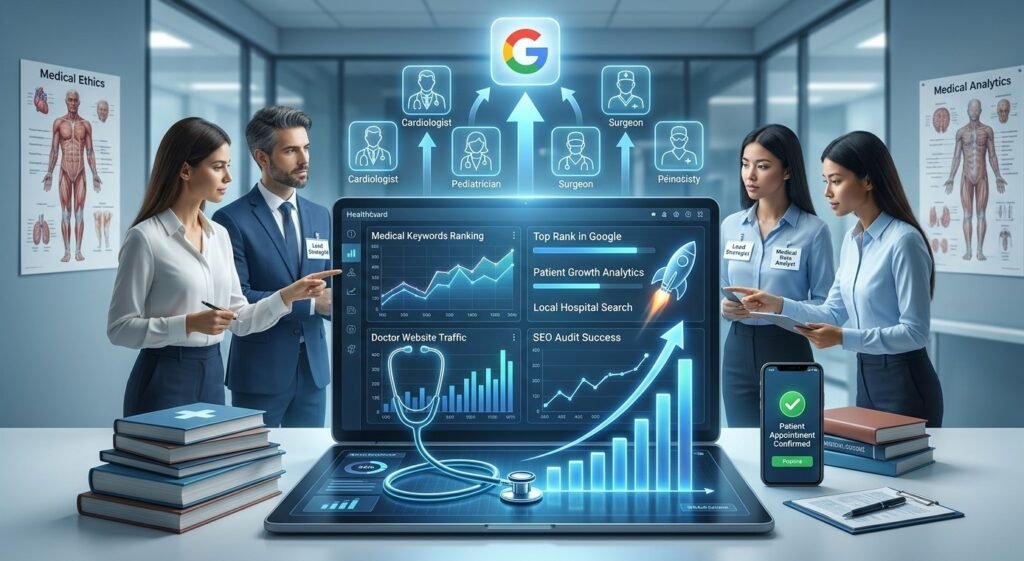
Why Is Medical SEO Important for Clinics?
Why Is Medical SEO Important for Clinics?
People often use search engines to research medical services, compare providers and find clinics in a particular area. If a practice’s website is difficult to discover or does not clearly explain its services, prospective patients may not find the information they need.
A well-planned SEO strategy can help clinics:
- Improve visibility for relevant service-related searches.
- Make clinic services, locations and contact details easier to understand.
- Strengthen their presence in local search results.
- Provide helpful answers to common questions.
- Improve the experience of visitors who arrive through organic search.
- Measure which pages and search queries attract attention.
SEO should complement a clinic’s wider marketing and patient communication activities. It should not be treated as a guaranteed or immediate source of new patients.
How Does Medical SEO Work?
Medical SEO brings several related activities together. The appropriate work depends on the practice’s current website, target services and search performance.
1. Technical SEO and Indexing
Search engines need to discover, crawl and understand a website’s important pages.
Technical SEO may include:
- Checking whether important pages can be crawled and indexed.
- Reviewing canonical URLs, redirects and XML sitemaps.
- Fixing broken internal links and other crawl-related problems.
- Improving mobile usability and page performance.
- Reviewing appropriate structured data.
- Identifying duplicate, thin or competing pages.
Technical changes should be based on an actual audit rather than a generic checklist. Not every website needs every possible technical adjustment.
2. On-Page SEO for Medical Services
Each important service should have a page that explains what the practice offers and helps visitors find relevant information.
On-page optimization may include:
- Descriptive page titles and headings.
- Clear explanations of services and treatment categories.
- Natural use of relevant search terms.
- Helpful image descriptions where appropriate.
- Contextual internal links between related pages.
- Clear contact and appointment information.
For example, a dermatology practice may need distinct, useful pages for dermatology services, acne treatment and other services it genuinely provides. Pages should not be created merely to target small keyword variations.
3. Local SEO for Clinics
Local SEO helps a healthcare practice improve its presence in searches connected to its services and geographic area.
Important activities can include:
- Claiming and maintaining an accurate Google Business Profile.
- Keeping business name, address, phone number and opening hours consistent.
- Selecting accurate business categories.
- Ensuring the website clearly identifies the practice’s services and location.
- Managing reviews in accordance with applicable policies.
- Building relevant local citations where appropriate.
- Improving location and service page quality.
Google’s local results are influenced by factors such as relevance, distance and prominence. Businesses cannot guarantee a position in the local map results simply by completing an optimization checklist.
Learn more about Local SEO for Clinics and Healthcare.
4. Healthcare Content Strategy
Useful content should address real questions and accurately describe the clinic’s services.
A healthcare content strategy may include:
- Service and specialty pages.
- Educational articles related to the practice’s services.
- Answers to frequently asked questions.
- Clear explanations of appointment processes.
- Relevant supporting content that connects visitors to service pages.
Medical information requires particular care. Content involving diagnoses, treatments, benefits or risks should be accurate, appropriately sourced and reviewed by a qualified healthcare professional when clinical judgment is needed.
SEO professionals can help structure, optimize and publish content, but they should not misrepresent their medical qualifications.
5. Website Trust and Credibility
Healthcare websites deal with topics that can affect people’s health and well-being. Visitors should be able to assess who is responsible for a website and whether its information is reliable.
Useful trust elements may include:
- Accurate practice and provider information.
- Clear author and reviewer details where relevant.
- Genuine professional qualifications and affiliations.
- Reliable sources for medical claims.
- Transparent contact information and service descriptions.
- Secure website functionality.
- Authentic reviews and testimonials used appropriately.
Google’s E-E-A-T framework refers to Experience, Expertise, Authoritativeness and Trustworthiness. It is a way of assessing content quality, not a single score that can be switched on through schema or a plugin.
Medical SEO and Google Business Profile
A clinic’s website and Google Business Profile serve related but different purposes.
The website can provide detailed information about services, providers, frequently asked questions and appointment processes. The Business Profile can help eligible local businesses present key information in Google Search and Maps.
A coordinated strategy should ensure that both sources contain accurate, consistent information.
Google Business Profile optimization may include reviewing categories, services, contact information, hours, photographs and review-management practices.
For more information, see Google Business Profile Optimization.
Medical SEO and Technical Website Structure
A technically sound website helps search engines access its important content and helps visitors navigate it.
Depending on the site, an SEO audit may examine:
- Indexability and canonicalization.
- XML sitemaps and robots directives.
- Internal linking and page hierarchy.
- Mobile experience and loading performance.
- Structured data that accurately describes the business.
- Broken links, redirects and duplicate content.
- Important pages that receive little or no internal linking.
Structured data should describe information that is genuinely present and accurate. Adding medical-related schema does not automatically establish authority or improve rankings.
Medical SEO and AI Search
Search experiences increasingly include AI-generated summaries and conversational responses. However, inclusion in an AI answer is not guaranteed by a specific optimization technique.
Healthcare websites can focus on fundamentals that help people and search systems understand their content:
- Clearly explain who provides a service and what it covers.
- Use descriptive headings and logically organized content.
- Answer relevant questions directly and accurately.
- Cite trustworthy sources for factual medical information.
- Keep business and provider information consistent.
- Maintain technically accessible, indexable pages.
- Demonstrate genuine expertise and transparent authorship.
These practices can support discoverability, but they do not guarantee visibility in Google’s AI features or third-party AI tools.
Medical SEO vs. General SEO
Medical SEO uses many of the same core principles as general SEO, but healthcare websites may require additional care around accuracy, trust and patient-related information.
| Area | General SEO | Medical SEO |
|---|---|---|
| Technical SEO | Crawling, indexing and performance | The same fundamentals, applied to healthcare websites |
| Content | Matches audience needs and search intent | Requires additional care with medical accuracy |
| Local SEO | Relevant for local businesses | Often important for clinics serving specific areas |
| Credibility | Clear ownership and reliable information | Provider details and appropriate clinical review may be especially important |
| Measurement | Impressions, clicks and conversions | Relevant visibility, enquiries and suitable business outcomes |
Medical SEO is not a separate Google ranking system. It is the application of established SEO practices to the needs and risks of healthcare-related websites.
Who Can Benefit from Medical SEO?
Medical SEO may be relevant to:
- Independent medical practices.
- Dermatology and skin clinics.
- Dental practices.
- Cosmetic and aesthetic clinics.
- General practitioners.
- Specialist healthcare providers.
- Multi-location healthcare organizations.
The right strategy depends on the services offered, the locations served, the website’s current condition and the type of searches that matter to the practice.
For dermatology-specific needs, explore Dermatology SEO Services.
How to Measure Medical SEO Performance
SEO work should be measured against clear objectives rather than rankings alone.
Useful metrics include:
- Impressions: How often pages appear in Google Search.
- Clicks: How often searchers visit the website from results.
- Click-through rate: The relationship between impressions and clicks.
- Average position: A search-performance metric that varies across queries and circumstances.
- Relevant landing pages: Which pages appear for important searches.
- Conversions: Qualified enquiries, calls or appointment actions that can be measured reliably.
Google Search Console can help identify queries and pages that receive impressions but few clicks. Analytics and suitable conversion tracking can help assess what visitors do after reaching the website.
Performance should be reviewed over time. No single metric guarantees that a clinic will gain patients or revenue.
My Medical SEO Approach
Irfan Mangol focuses on SEO strategy, technical website improvements, local search optimization and content structure for healthcare-related websites.
A project can begin with an assessment of the existing website, its search visibility and its most important service pages. Recommendations should then be prioritized according to business relevance, technical impact and available evidence.
A typical workflow may include:
- Website audit: Review indexing, technical health, page structure and existing search performance.
- Keyword and intent mapping: Match relevant searches to the most appropriate existing pages.
- On-page improvements: Refine titles, headings, content, internal links and calls to action.
- Local SEO review: Assess Google Business Profile and relevant local signals where applicable.
- Content recommendations: Identify missing information and useful content opportunities.
- Measurement: Track changes in impressions, clicks, rankings and measurable enquiries.
The specific scope depends on the website and agreed project requirements. Recommendations and expected outcomes should be based on the actual audit, not invented case studies or guaranteed ranking claims.
Frequently Asked Questions About Medical SEO
What is medical SEO?
What is medical SEO?
Medical SEO is the process of improving a healthcare website’s visibility in relevant search results through technical SEO, useful content, on-page optimization and local search improvements.
How is medical SEO different from general SEO?
The core SEO principles are similar. Medical SEO applies them to healthcare websites, where accurate information, appropriate clinical review and trust can be particularly important.
How long does medical SEO take to work?
There is no universal timeline. Results depend on the website’s current condition, competition, content quality, technical issues and the work completed. Performance should be assessed over time using search and conversion data.
Does medical SEO guarantee first-page rankings?
No. No responsible SEO professional can guarantee a particular Google ranking. SEO work can improve a website’s eligibility, relevance and overall search performance, but rankings remain subject to many factors.
Is Google Business Profile part of medical SEO?
It can be an important part of local SEO for eligible healthcare practices. Its relevance depends on the type of business, its service area and the searches it wants to reach.
Can medical SEO help a clinic appear in AI search results?
Good content structure, accurate information and accessible pages may support discoverability. However, no method guarantees inclusion in AI-generated search results.
What should a clinic review before investing in medical SEO?
A clinic should understand its current search performance, technical issues, service-page quality, local visibility, competition and conversion tracking. An audit can help identify the highest-priority opportunities.
Need Help With Your Medical SEO?
Need Help With Your Medical SEO?
If you manage a healthcare website and want to understand its current search performance, the next step is to identify what is preventing important pages from being discovered, ranking competitively or generating relevant enquiries.
Explore Medical SEO Services to learn more about the available SEO support.
You can also contact Irfan Mangol to discuss your website, target services and SEO priorities.
SEO is a long-term improvement process. The goal is to build a useful, technically accessible and trustworthy website that supports relevant search visibility and helps visitors take the next step.