
Introduction: Why Clinics Need a Structured Medical SEO Strategy
Most clinics fail in SEO not because of lack of effort, but because they operate without a structured Medical SEO system.
Random SEO activities—posting blogs, adding keywords, or running ads—do not create sustainable patient acquisition.
Modern healthcare search is controlled by:
- Google entity recognition system
- Local ranking algorithms (Map Pack)
- E-E-A-T trust signals
- AI-driven search interpretation (SGE + LLM systems)
A Medical SEO strategy for clinics is a structured system that aligns all these ranking layers to convert search visibility into patient bookings.
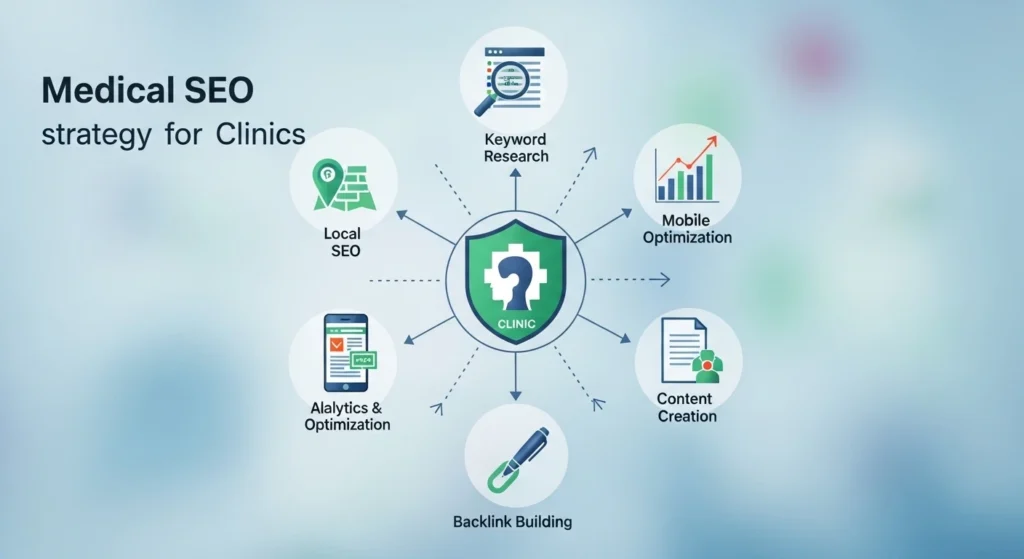
Step 1: Define Clinic Entity Structure (Google Foundation Layer)
The first step in Medical SEO is establishing a clear clinic entity identity in Google’s ecosystem.
Google must understand:
- Who the clinic is
- What medical services it offers
- Where it operates
- Which patients it serves
Core Entity Mapping:
- Clinic entity (brand + medical practice)
- Service entity (e.g., dermatology, dental, general physician)
- Location entity (city, region, country)
Without this structure, Google cannot assign authority to your clinic.
Step 2: Build Service-Based SEO Architecture
Clinics must move away from generic pages and build service-specific SEO pages.
Each medical service should have:
- Dedicated landing page
- Search intent alignment
- Patient-focused content
- Internal linking structure
Example structure:
- Dermatology services
- Acne treatment
- Skin allergy treatment
- Cosmetic dermatology
This improves semantic clarity and strengthens topical authority.
This directly supports:
Dermatology SEO Services
Step 3: Dominate Local Search (Google Map Pack System)
Local SEO is the highest conversion channel for clinics.
Patients searching “near me” queries are high-intent users.
To rank in Google Maps, clinics must optimize:
- Google Business Profile (GBP)
- Reviews velocity and quality
- NAP consistency (Name, Address, Phone)
- Local citations and trust signals
- Geo-relevance optimization
Key Outcome:
Top 3 map pack ranking = consistent patient flow.
This system is part of:
Local SEO for Clinics and Healthcare
Step 4: Build Medical Authority Using E-E-A-T
Google evaluates healthcare websites under strict YMYL (Your Money Your Life) standards.
To build authority, clinics must demonstrate:
- Expertise (qualified medical professionals)
- Experience (real clinical practice)
- Authority (backlinks + citations)
- Trust (reviews, transparency, credentials)
Medical SEO without E-E-A-T fails in competitive markets.
Step 5: Optimize for AI Search (SGE + LLM Systems)
Search is shifting toward AI-generated results.
To appear in AI answers, clinics must:
- Use structured medical explanations
- Provide direct question-based answers
- Maintain entity clarity (clinic + service + location)
- Avoid keyword stuffing and generic content
AI systems prioritize semantic clarity over keyword density.
Step 6: Convert Traffic into Patient Bookings
SEO success is not traffic—it is patient acquisition.
Every clinic website must include:
- Appointment booking system
- WhatsApp/call integration
- Consultation CTAs
- Trust signals (reviews, certifications)
Without conversion optimization, SEO traffic has no business value.
Step 7: Strengthen Website UX for SEO Performance
Website design directly impacts SEO performance.
A clinic website must:
- Load fast on mobile devices
- Be easy to navigate
- Highlight services clearly
- Build trust within seconds
Poor UX reduces both rankings and conversions.
This aligns with:
Clinic and Healthcare Website Design
Step 8: Build Internal SEO Ecosystem (Cluster Strategy)
A strong Medical SEO strategy is not isolated pages—it is a cluster system.
Each service page should connect to:
- Awareness content
- Problem-solving content
- Conversion-focused content
- AI/technical SEO content
This creates a topical authority graph inside Google.
Core hub system:
Medical SEO Services
Step 9: Continuous SEO Optimization System
Medical SEO is not a one-time setup.
It requires continuous optimization:
- Content updates
- Ranking monitoring
- Local SEO adjustments
- Competitor tracking
- Authority strengthening
Clinics that do not maintain SEO lose rankings over time.
FINAL SUMMARY
A successful Medical SEO strategy for clinics is built on:
- Entity-based SEO structure
- Local search dominance
- E-E-A-T authority signals
- AI-search optimization
- Conversion-focused design
- Internal cluster architecture
Without this system, clinics remain invisible in competitive healthcare markets.
CTA
If your clinic is not generating consistent patient inquiries from Google, the issue is not traffic—it is missing structured Medical SEO architecture.
Build a scalable system using: