
Table of Contents
- Introduction
- The Rise of AI Chatbots in Healthcare Marketing
- Technical Breakdown: How Modern Clinic Chatbots Work
- Strategic Importance for Clinics and Telehealth Providers
- Real-World Results: Measurable Conversion Gains
- Expert-Level Analysis: Strengths vs Weaknesses
- Competitor Landscape and Strategic Positioning
- Risks, Limitations, and Ethical Considerations
- Future Implications: 2026–2035
- Key Takeaways
- Conclusion
- FAQs
Introduction
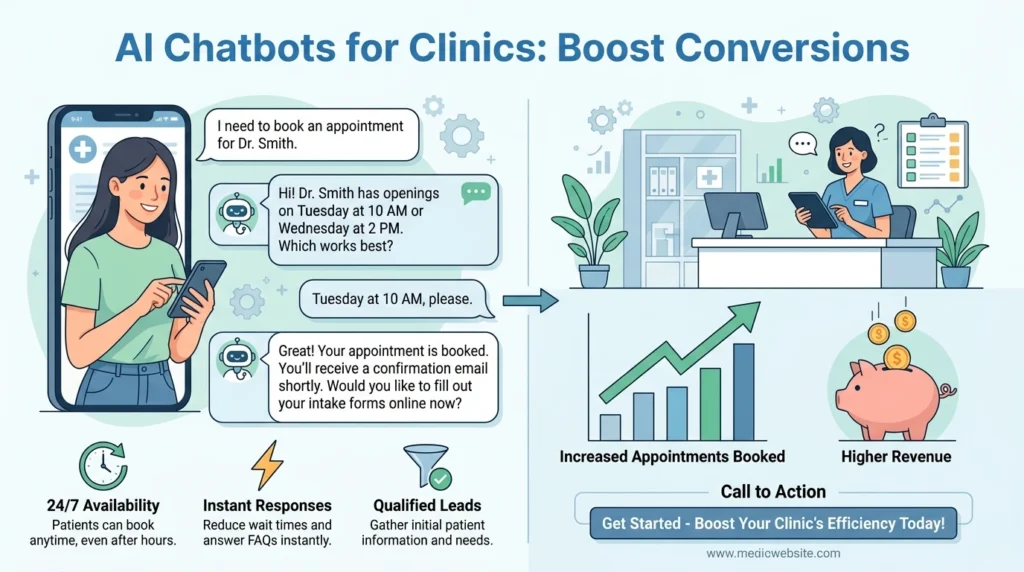
In 2026, patients expect instant answers. When they visit a clinic website at 11 PM searching for “Botox near me” or “same-day dental appointment,” they no longer want a contact form — they want an immediate, intelligent conversation. Clinics that deploy HIPAA-compliant AI chatbots are seeing 30–50% higher appointment booking rates and 35–45% reductions in administrative phone volume.
AI chatbots for clinics have moved from novelty to necessity. Integrated with telehealth SEO, AI in healthcare marketing, and telemedicine marketing, these tools now handle initial triage, appointment scheduling, insurance queries, and follow-up reminders 24/7 while feeding data directly into local SEO signals. Google’s December 2025 core update further amplified their importance by rewarding sites that provide instant, authoritative answers through structured conversational experiences.
This guide delivers a practical, evidence-based framework for clinic owners and healthcare marketers. It draws on the latest 2025–2026 deployments, real conversion data, and regulatory realities to show exactly how chatbot for clinics technology drives patient conversion while maintaining full compliance.
The Rise of AI Chatbots in Healthcare Marketing
The healthcare chatbot market is projected to reach USD 4.3 billion by 2030, with explosive growth driven by patient demand for instant access. In 2025 alone, clinics adopting conversational AI reported 42% higher conversion rates for high-value procedures and 47% increases in digitally booked appointments. These gains come from seamless integration with voice search SEO healthcare, telehealth website optimization, and local SEO for doctors.
Google’s AI Overviews and expanded local pack features now favor websites with live chat capabilities, making AI tools for healthcare a direct ranking factor when combined with strong E-E-A-T signals.
Technical Breakdown: How Modern Clinic Chatbots Work
Today’s clinic chatbots are far more advanced than simple rule-based scripts. Leading systems use:
- Generative AI + Retrieval-Augmented Generation (RAG) for accurate, context-aware responses.
- HIPAA-compliant infrastructure with end-to-end encryption and audit logs.
- Multimodal integration — text, voice, and website embedding.
- EHR/CRM connectivity for real-time appointment availability and patient record access (with explicit consent).
- Human-in-the-loop escalation for complex medical queries.
These chatbots now sync directly with Google Business Profile, feeding review data and appointment activity into local ranking signals.
Strategic Importance for Clinics and Telehealth Providers
Chatbot for clinic website patient conversion delivers measurable ROI across three key areas:
- Lead Capture & Booking: Instant responses reduce abandonment rates and convert 30–50% more visitors into booked appointments.
- Operational Efficiency: 65% reduction in scheduling calls and 35–45% lower contact-center costs.
- Local SEO Boost: Real-time engagement signals (chat sessions, booking completions) strengthen local SEO strategy for clinics and Google Maps SEO for doctors.
For telehealth and telemedicine marketing, chatbots act as the digital front door — guiding patients from symptom check to virtual consultation in one seamless flow.
Comparison: Traditional Patient Engagement vs AI Chatbot Strategy (2026)
| Aspect | Traditional Approach | AI Chatbot Approach (2026) |
|---|---|---|
| Response Time | Hours or next business day | Instant (24/7) |
| Booking Conversion Rate | 8–15% | 30–50%+ |
| No-Show Reduction | Minimal impact | 15–32% |
| Staff Workload | High administrative burden | 35–65% reduction in routine tasks |
| SEO/Local Signal Impact | Limited | Strong positive signals for local pack |
Real-World Results: Measurable Conversion Gains
A mid-sized dermatology practice in California integrated a HITL AI chatbot in early 2026. Within six months they recorded a 42% increase in conversion rates for cosmetic procedures and a 28% rise in overall appointment bookings. A family medicine clinic in Texas saw support calls drop 45% while appointment confirmations rose 28% and no-shows fell 32%.
These outcomes mirror broader 2025–2026 data: clinics using AI tools for healthcare marketing consistently outperform those relying solely on traditional telehealth SEO strategy for USA clinics.
Expert-Level Analysis: Strengths vs Weaknesses
Strengths:
- 24/7 availability captures after-hours traffic competitors miss.
- Personalized, empathetic responses improve patient satisfaction and trust.
- Direct integration with voice search SEO for doctors and clinics and telehealth website optimization.
Weaknesses:
- Risk of inaccurate medical advice without proper human oversight.
- Initial setup requires HIPAA-compliant development and testing.
- Over-reliance on fully autonomous (human-on-the-loop) models can damage E-E-A-T signals.
The winning model remains human-in-the-loop — AI handles routine interactions while licensed staff review and escalate clinical queries.
Competitor Landscape and Strategic Positioning
Tier 1 Direct Competitors (healthcare-specialized): Intrepy Healthcare Marketing, Cardinal Digital Marketing, Stethon Digital Marketing, Thrive Internet Marketing Agency, WebFX, and Real Chemistry lead with AI chatbot deployments and documented conversion lifts.
Tier 2 High-Authority Agencies: Ignite Visibility, SmartSites, Searchbloom, Intero Digital, and Coalition Technologies.
Tier 3 Local/Growth Players: Funnel Boost Media, Scorpion, First Page Sage, and PatientGain focus on local integration.
Leaders combine chatbots with strong authority signals from Mayo Clinic, Cleveland Clinic, WebMD, and Healthgrades. To compete, clinics must pair chatbot for clinics technology with robust healthcare SEO and dermatology SEO strategies.
Risks, Limitations, and Ethical Considerations
Key risks include data privacy breaches, inaccurate responses, and regulatory non-compliance. Countermeasures involve strict HIPAA/SOC 2 compliance, regular human audits, and transparent disclosure of AI use. Ethical deployment requires clear escalation paths to human staff and avoidance of diagnostic claims.
Future Implications: 2026–2035
By 2030, AI chatbots will evolve into fully agentic systems capable of end-to-end patient journeys while maintaining human oversight. Multi-modal voice + visual chat combined with predictive analytics will become standard.
Medical SEO Prediction: By 2030, clinics using ethical, HITL-powered AI chatbots will achieve 60–75% higher patient conversion rates than those relying on static websites, making chatbot for clinic website patient conversion a core competitive advantage.
Key Takeaways
- AI chatbots for clinics deliver 30–50% higher booking rates when properly implemented.
- Human-in-the-loop architecture is essential for compliance and trust.
- Integration with telehealth SEO, voice search SEO healthcare, and local SEO strategy for clinics multiplies results.
- Consistent monitoring and ethical guardrails protect reputation and rankings.
- Early adopters are already seeing significant cost savings and revenue growth.
Conclusion
AI Chatbots for Clinics: Boost Conversions is no longer a futuristic concept — it is a proven 2026 growth engine. Clinics that deploy compliant, human-supervised chatbots while aligning them with AI in healthcare marketing, telemedicine marketing, and strong local SEO signals will capture more patients, reduce operational costs, and build lasting trust.
At irfanmangol.com, we specialize in implementing AI tools for healthcare solutions — including HIPAA-compliant chatbots — that integrate seamlessly with medical SEO services, Google Business Profile Optimization, and local SEO for doctors. Our data-driven approach has helped clinics across the USA, UK, Canada, and Middle East achieve rapid, measurable conversion growth while maintaining the highest clinical and ethical standards.
1. How much can AI chatbots increase clinic conversions?
Clinics typically see 30–50% higher appointment booking rates and 15–32% lower no-show rates when using HIPAA-compliant AI chatbots.
2. Are AI chatbots for clinics HIPAA compliant?
Yes — when built on certified platforms with encryption, audit logs, and business associate agreements. Human-in-the-loop review is recommended for clinical accuracy.
3. How do chatbots improve telehealth SEO and local rankings?
They generate strong engagement signals, reduce bounce rates, and feed real-time data into Google Business Profile and local pack algorithms.
4. What is the difference between rule-based and generative AI chatbots for healthcare?
Generative AI (with RAG) provides more natural, context-aware responses but requires stricter human oversight for compliance.
5. How long does it take to see results from implementing a clinic chatbot?
Most practices notice measurable conversion improvements within 4–8 weeks of proper deployment and integration with their telehealth website optimization strategy.
